
Data and Information
Every computer system, and every decision you make using one, starts with data and ends with information. This note explains what separates the two, how one becomes the other, and why the distinction shows up in almost every ICT exam question about computer systems.
What is Data?
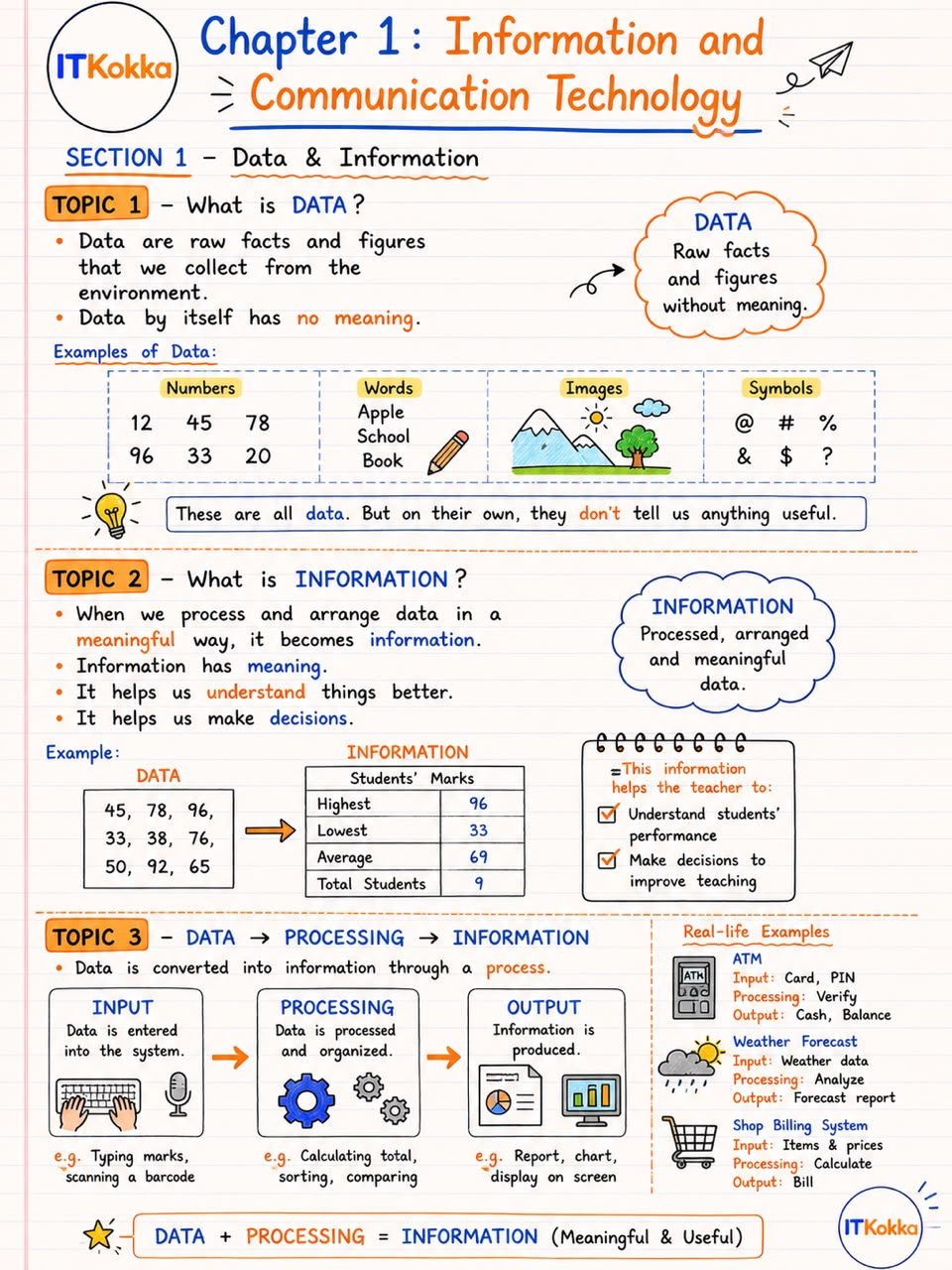
Data is raw facts and figures collected from the environment, before anyone has organized or interpreted them.
Example- Numbers:
12, 45, 78, 96, 33, 20 - Words:
Apple, School, Book - Images: a photo of a mountain
- Symbols:
@, #, %, &, $, ?
Each of these is data. Notice that none of them, on their own, tell you anything you can act on. A list of numbers doesn't say whether a student passed. A photo doesn't say what the weather will be tomorrow. That is the defining trait of data:
- It is unprocessed, collected but not yet worked on.
- It can be numbers, text, images, or symbols.
- It has little or no meaning by itself.
- It is used as input to a system or a process.
Key Idea: Data on its own does not help you make a decision. It needs to be processed first.
What is Information?
Information is data that has been processed, organized, and arranged so that it has meaning and is useful for a purpose.
ExampleA teacher collects a set of marks:
45, 78, 96, 33, 38, 76, 50, 92, 65
On their own, these are just data. Once the teacher works with them:
| Item | Value |
|---|---|
| Highest mark | 96 |
| Lowest mark | 33 |
| Average mark | 69 |
| Total students | 9 |
This table is information. It has meaning: it tells the teacher who is struggling and who is doing well, and it supports a real decision, adjusting how the next lesson is taught.
Information:
- Has meaning, unlike raw data.
- Helps people understand a situation.
- Helps people make decisions.
- Is the output of a system, produced from data that went in as input.
Key Idea: Data becomes information only after it is processed. The same numbers can stay meaningless data forever if nobody works with them.
How Data Becomes Information: the Process
Turning data into information always follows the same three stage process, no matter what kind of system is doing it, a computer, an app, or a person doing the calculation by hand.
This input, processing, output pattern is one of the most tested ideas in ICT, because it applies to every computer system you will ever study, not just this topic.
Real-World Example: ATM- Input: the card and the PIN
- Processing: the system verifies the PIN against the account
- Output: cash is dispensed, and the updated balance is shown
- Input: temperature, humidity, and wind readings
- Processing: the readings are analyzed
- Output: a forecast report
- Input: items scanned and their prices
- Processing: the total is calculated
- Output: the printed bill
In every case above, the input by itself is just data, a PIN, a temperature reading, a price. It becomes useful, becomes information, only after the system processes it.
Data vs Information
| Feature | Data | Information |
|---|---|---|
| Meaning | None on its own | Meaningful |
| State | Raw, unprocessed | Processed |
| Role in a system | Input | Output |
| Use | Cannot be used directly for a decision | Used to make a decision |
| Example | 70, 80, 35, 40 | Highest mark = 80 |
A common exam mistake is treating data and information as two different types of content. They are not. The same underlying facts can be data at one moment (a raw mark) and information a moment later (an average, once calculated). What changes is whether processing has happened.
Exam-Focused Points
Key Idea: Data + Processing = Information. If a question describes numbers, text, or readings with no analysis applied, call it data. If it describes something calculated, sorted, or compared, call it information.
- Data is input, information is output, of the same system.
- Meaning is the deciding factor: no meaning, it's data; meaning and usefulness, it's information.
- The input, processing, output structure applies to every computer system (ATMs, billing systems, weather systems, and beyond), so learn it once and reuse it.
Summary
- Data is raw facts and figures with no meaning by themselves.
- Information is data that has been processed and arranged so it has meaning.
- Every system converts data into information through input, processing, and output.
- The same facts can be data before processing and information after it, nothing new is added except organization and meaning.
Remember: Data + Processing = Information